

I’m thrilled to be taking the train to Regensburg to visit my friend Michaela and see the Christmas market there. Two hours of reading time, I think, but at the same time I can’t keep myself from looking out the window at the never-ending beautiful landscape. Gently rolling hills and pine forests alternate with black fields (thanks to the Ice Age, the soil is so fertile in Bavaria it’s black), surrounding fairy-tale towns with church spires reaching up from the highest hill.
Who lives in these towns, I wonder, and what do they do for a living? They can’t all be farmers, but they can’t all be remote office workers, either. Life outside of metropolitan Munich centers around these small towns and villages and is very foreign to me. The sights outside the window capture my imagination and draw me away from my reading.
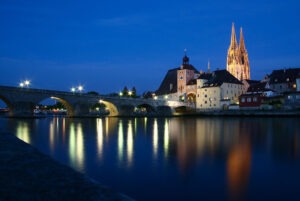
Many villages and two and a half pages later, I arrive together with a crowd of other Christmas market visitors. Regensburg is the perfect place for a nostalgic Christmas market, especially since it is a real-life Sleeping Beauty. A bustling, profitable town in the Middle Ages, it has kept its original character throughout the centuries and is the largest medieval city north of the Alps. It has the reputation of being Italy’s northernmost city, a tribute not just to its beauty but to Germans’ nostalgic penchant for Italy, the land where the weather is warm and the waiters are friendly. With no money for any major renovations, it wasn’t until the 1960s that Regensburg attracted major companies who brought much-needed tax income. By then the city was aware of its unique character and instead of modernizing the city beyond recognition, they chose to restore it.
Regensburg also reminds me of one of my best embarrassing foreigner moments. It was on a bike tour with German friends on the other side of Bavaria, and we were approaching another picturesque city called Donauwörth (Donau means Danube and Wörth is an old German word for an island in the middle of a river). The city loomed ahead of us, just behind a bridge over a river, and as we cycled closer, something dawned on me.
“Hey,” I exclaimed like I had just discovered the atom, “is that where the name Donauwörth comes from? From the Donau River?” Now this was exciting.
“Go-oo-od, Brenda, go-oo-od!” said my friend Matthias, nodding his head the way he did to his two young sons, using the same voice he uses for his dog when he pats it on the head. “Good boy!”
My excitement quickly faded into sheepishness.
“And what river is Regensburg named after?” he continued in his schoolmaster tone.
Back then I had never heard of the Regen River, but this had to be answer.
“The Regen!” I said, trying to sound triumphant.
This all came back to me now as I stood with Michaela, looking down at the confluence of the three rivers that catapulted Regensburg into the center of the medieval scene: the Danube, the Naab and the Regen. Standing above the churning waters of the Danube, I imagined how for centuries, boats carrying valuable salt from the Alps traveled right under this very bridge, making the city rich with their customs duties. In the summer this stone bridge is mobbed with tourists, but now it was mostly locals, scurrying across to escape the cold wind.
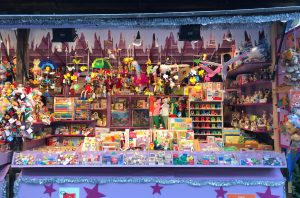
We certainly weren’t tourists (who me? I’m an honorary Bavarian!), but were headed for one of Regensburg’s charming Christmas markets. Nuremberg puts on the most famous and largest market, but I wasn’t interested in bigger and better, since Munich offers that. The Christmas markets downtown there have converged into a giant red beast of shiny trinkets and lights that spreads its tentacles farther every year. What started at the center at Marienplatz has now crept slowly down side streets, up the pedestrian zone, and spilled into inner courtyards. There are themed Christmas markets: medieval, arts and crafts, and the general mumbo-jumbo markets of ornaments, fake Fabergé eggs (I know this detail because I actually bought two one year), lambskin slippers (bought those once too, for my niece) and lots of mulled wine (I’ve bought a lot of that).
How chicken legs, triangles and sphincters will make you laugh
There is endless food such as all kinds of sausages, Flammkuchen (sort of a French pizza), French fries, and potato pancakes. People gather at stands to drink mulled wine (red or white), stamping their feet to keep warm, and the scent of sugar-coated nuts is everywhere. But best of all, there are Lebkuchen, a delicacy from the Middle Ages that loses all charm in the translation: life cake. This last item needs special mention, as it is central to German Christmas culture.
For a typical, sweet-toothed American, learning to like Lebkuchen consists of several stages.
In stage one, you take a bite of this cake-like cookie under the expectant, hopeful gaze of the German person who has been put in charge of acculturating you. Three people shared the task of Germanizing me: my husband and both his parents. It was his Mom who gave me my first Lebkuchen.
“Mmm, chocolate…” I said, trying to be positive. But inside it was sort of dry and crumbly, with lots of nuts and spices. It wasn’t bad, but not exactly…good.
“Mmm, interesting,” I repeated. Sorry, Americans just like sweet stuff, I was thinking. This thing needed a lot more sugar.
In stage two, your addiction to sugar has subsided somewhat, having been subjected to less sweet German cakes and other desserts. You begin to appreciate the flavor for what it is: almond, chocolate, orange, lemon, and various spices, rather than the sweet, really sweet, swe-e-e-t, and I’m-going-to-be-sick sweet of many American desserts. A wedding cake is a good example of this. I believe it’s part of a secret series of early tests for a marriage. If you can eat a piece of it while still smiling and beaming at the camera and wedding guests, you are ready to swallow all the other stuff headed your way in the upcoming years!
Those spices in a Lebkuchen have particular importance, since in the Middle Ages, being able to afford to enjoy these meant you were very wealthy, for spices were still an expensive luxury.
Or as my husband puts it: “Lebkuchen were the Mercedes of the Middle Ages.”
In the final stage of Lebkuchenology, you can’t wait for Christmas to come so you can get good Lebkuchen again. They start selling the cheap ones in the supermarket as early as September, but the good ones, the really good ones, don’t arrive in the bakeries until late November.
Back in Regensburg, I try my luck at one of my favorite little games. It’s when I try to speak Bavarian dialect without anyone noticing that not only am I not Bavarian, I’m freakin’ American. In Regensburg they speak a much stronger dialect than in Munich. This is my big chance.
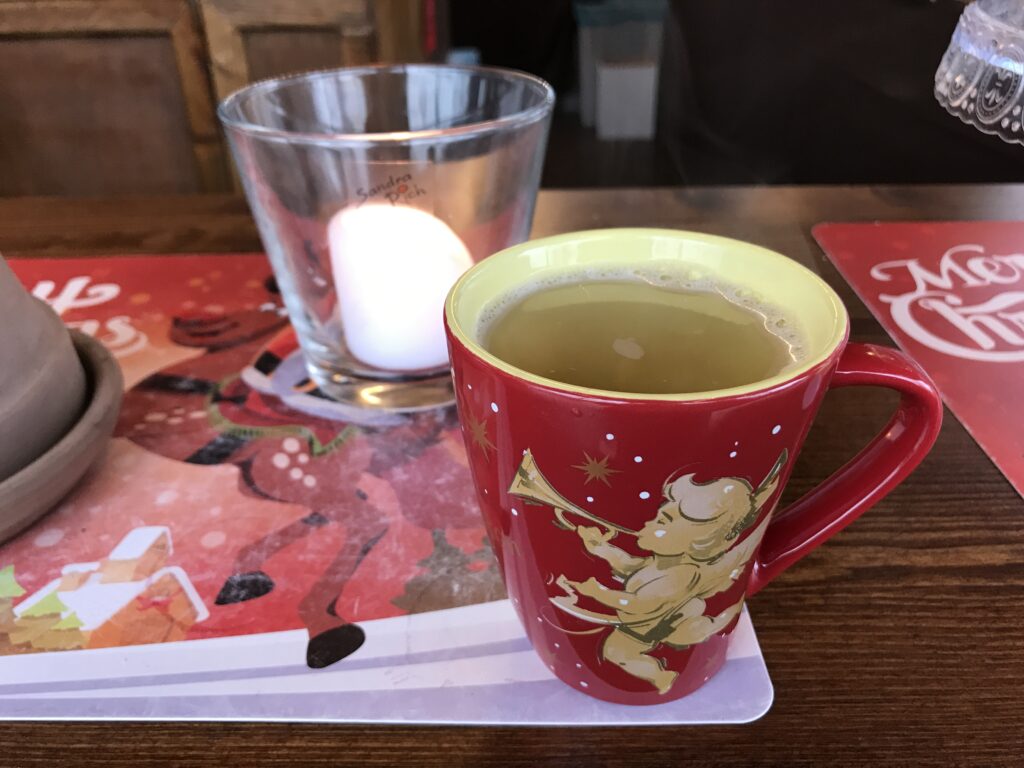
“A’ Haferl weissen Glühwein, bitte!” I say to the burly guy manning the stand, smiling. A mug of white mulled wine, please. It looks like I pulled it off since he gives me what I ordered.
Of course, this game only works when I say a maximum of five words, preferably in the midst of a large, noisy crowd – with the wind blowing. Only then can I get away with it. Speaking dialect when you’re not from that region is on par with trying to dance ballet in tennis shoes. You may pull off a pirouette or two, but very soon people will look down at your feet. And start to snicker.
On the train ride home, I bask in the afterglow of the mulled wine, happy to be on a warm train after spending an afternoon out in the cold. Now that’s it dark, there is no temptation to look out the window at the scenery. I take off my coat, hang it on the hook behind me and settle down with my book, determined to make up for lost time.
Within ten minutes, I’m asleep.
Brenda Arnold

Your essay paints a beautiful portrait of the life of an almost ordinary person in Germany. Having never been there myself, I really enjoyed the virtual tour. I could almost see you rubbing off your cold hands once you got back on the train on your way home. Keep writing!
Your essay paints a beautiful portrait of the life of an almost ordinary person in Germany. Having never been there myself, I really enjoyed the virtual tour. I could almost see you rubbing off your cold hands once you got back on the train on your way home. Keep writing!
Thank you so much, Esther! So wonderful to get your feedback and I’m thrilled I was able to transport you (at least virtually) to a Christmas market in Germany. And thanks for the encouragement to keep writing, something all of us writers need!
Your essay paints a beautiful portrait of the life of an almost ordinary person in Germany. Having never been there myself, I really enjoyed the virtual tour. I could almost see you rubbing off your cold hands once you got back on the train on your way home. Keep writing!